

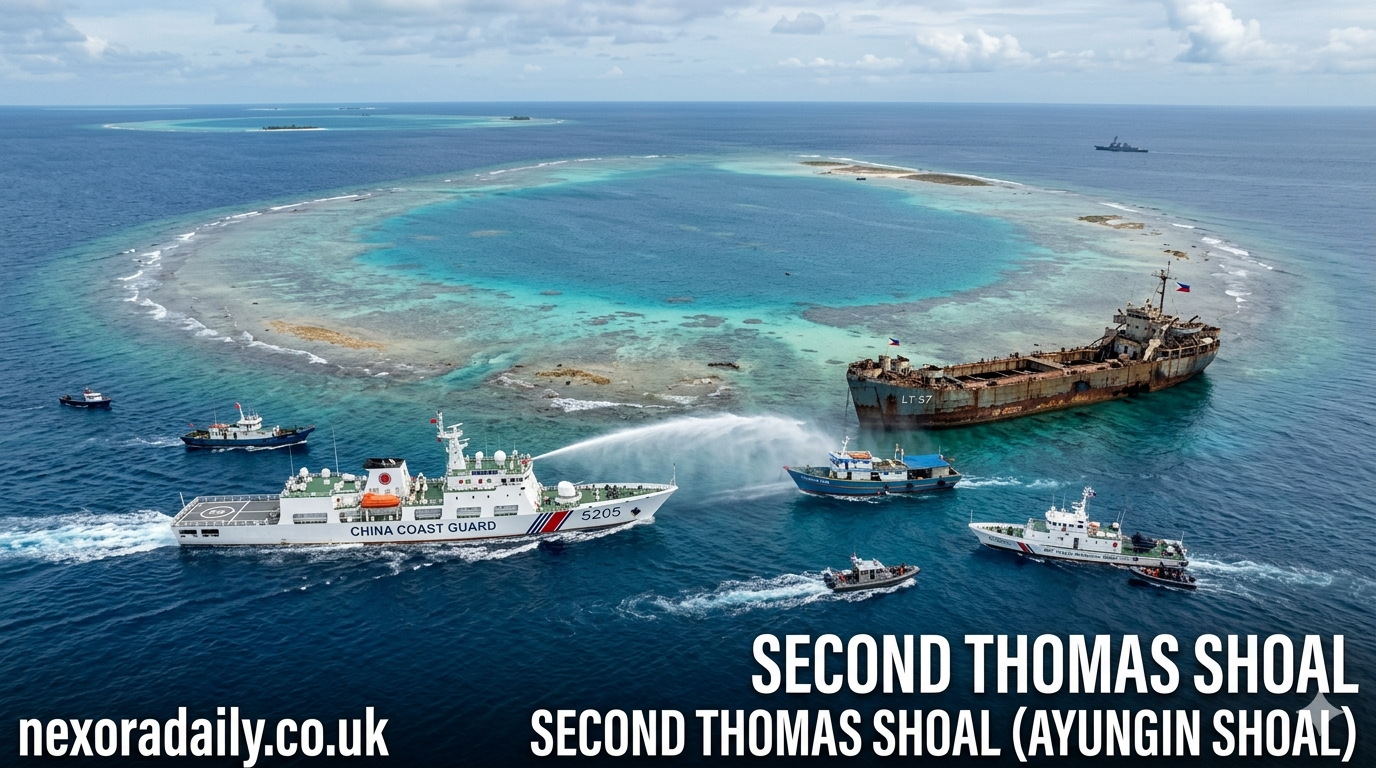
The South China Sea has become one of the most contested maritime regions in the world, and among its many disputed territories, Second Thomas Shoal stands out as a major geopolitical hotspot. Located in the strategically important Spratly Islands, this remote reef has repeatedly made international headlines because of rising tensions between the Philippines and China.
Despite being a submerged reef that many people had never heard of a decade ago, Second Thomas Shoal now plays a central role in regional security discussions, naval confrontations, and debates over international maritime law. Governments, military analysts, and global observers closely watch developments around this area because even a small incident could trigger larger diplomatic consequences.
This article explores the history, location, legal significance, military importance, recent confrontations, and future implications of Second Thomas Shoal.
What Is Second Thomas Shoal?
Second Thomas Shoal, known as Ayungin Shoal in the Philippines and Ren’ai Jiao in China, is a submerged reef located in the eastern section of the Spratly Islands in the South China Sea.
The shoal lies approximately:
- 105 nautical miles west of Palawan, Philippines
- Within the Philippines’ Exclusive Economic Zone (EEZ)
- Roughly 600 miles from mainland China
Although the reef remains underwater during high tide, it has become highly significant due to competing territorial claims.
Under international maritime law, particularly the United Nations Convention on the Law of the Sea (UNCLOS), Second Thomas Shoal falls within the Philippines’ 200-nautical-mile Exclusive Economic Zone. However, China claims nearly the entire South China Sea through its controversial “nine-dash line.”
This overlapping claim has transformed the reef into a persistent source of conflict.
Geographic Importance of Second Thomas Shoal
At first glance, Second Thomas Shoal may appear insignificant because it lacks permanent infrastructure and is largely submerged. However, its location makes it strategically valuable.
Access to Shipping Routes
The South China Sea handles trillions of dollars in global trade annually. Major shipping lanes pass through these waters, connecting:
- East Asia
- Southeast Asia
- Europe
- The Middle East
- North America
Control over disputed territories like Second Thomas Shoal can strengthen a country’s influence over these critical routes.
Natural Resources Around the Area
The surrounding waters are believed to contain:
- Oil reserves
- Natural gas deposits
- Rich fishing grounds
These resources increase the importance of maintaining control over maritime territories.
Countries surrounding the South China Sea depend heavily on fisheries for food security and employment, making disputes over access even more serious.
Historical Background
Understanding the dispute requires examining how Second Thomas Shoal became militarized.
Philippine Occupation in 1999
In 1999, the Philippines intentionally grounded the naval ship BRP Sierra Madre at Second Thomas Shoal.
The vessel was deliberately placed there to strengthen Manila’s territorial claim after China expanded activity in nearby reefs.
The rusting warship remains stationed there today and serves as an outpost occupied by Filipino marines.
This move created a physical symbol of Philippine sovereignty.
China’s Response
China strongly opposed the grounding of the ship and demanded its removal.
Beijing argues that:
- The Philippines violated agreements
- The vessel should be removed
- China holds historical rights over the area
Over time, Chinese coast guard vessels increased patrols around the reef.
The Role of BRP Sierra Madre
The BRP Sierra Madre has become one of the most recognizable symbols of the dispute.
The ship is:
- Old and deteriorating
- Rust-covered
- Permanently grounded
- Occupied by Philippine military personnel
Despite its poor condition, the vessel remains critical.
Filipino troops stationed aboard rely on frequent resupply missions for:
- Food
- Water
- Fuel
- Medical supplies
These missions have become increasingly dangerous.
Why China Wants It Removed
China believes the ship’s presence strengthens Philippine control over the area.
Removing it could weaken Manila’s claim.
Beijing frequently accuses the Philippines of attempting construction work to reinforce the vessel.
China has attempted to block repair and supply missions.
Legal Disputes and International Law
One of the most important developments occurred in 2016.
Hague Arbitration Ruling
The Philippines filed a legal case against China in an international tribunal under UNCLOS.
The Permanent Court of Arbitration ruled that:
- China’s nine-dash line claims had no legal basis
- Certain disputed features were not entitled to full maritime zones
- The Philippines’ maritime rights had been violated
This ruling significantly affected discussions surrounding Second Thomas Shoal.
China rejected the decision.
UNCLOS and Maritime Rights
UNCLOS establishes rules for:
- Territorial waters
- Exclusive Economic Zones
- Navigation rights
- Resource rights
Because Second Thomas Shoal lies inside the Philippines’ EEZ, Manila argues international law supports its position.
Rising Tensions in Recent Years
The situation has intensified significantly.
Water Cannon Incidents
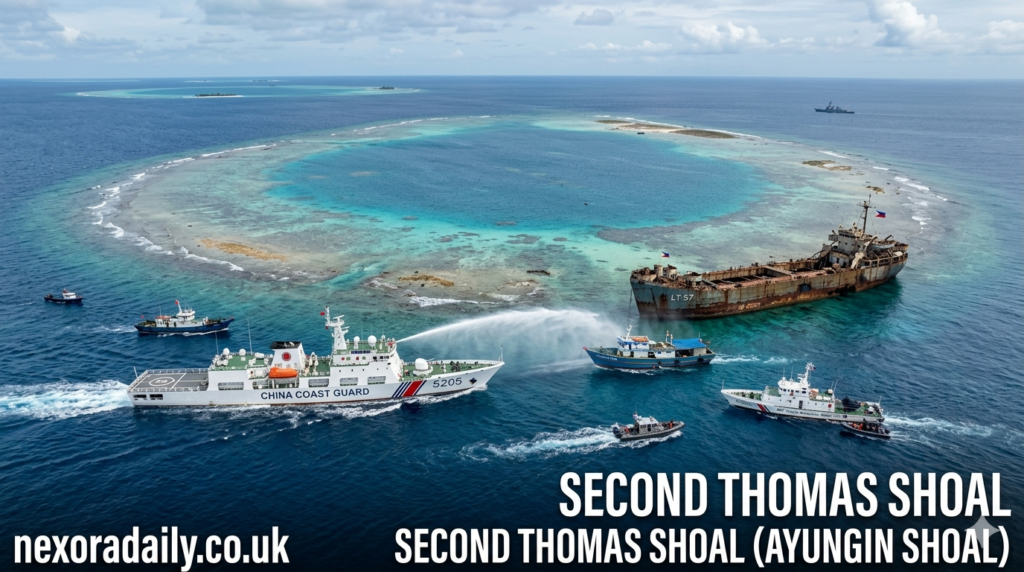
Chinese coast guard ships have repeatedly used water cannons against Philippine vessels.
These incidents damaged supply boats and increased international concern.
Such confrontations often involve:
- Dangerous maneuvers
- Ship collisions
- Blockades
- Harassment claims
Naval Standoffs
Military vessels from both sides regularly operate nearby.
This increases the risk of miscalculation.
Even minor accidents could escalate quickly.
The Role of the United States
The United States has become increasingly involved in regional security.
Washington supports freedom of navigation in the South China Sea.
The U.S. has repeatedly stated that attacks on Philippine forces could trigger mutual defense obligations under the U.S.-Philippines Mutual Defense Treaty.
This adds another layer of geopolitical complexity.
Joint Military Exercises
The United States and the Philippines regularly conduct military drills.
These exercises aim to:
- Improve readiness
- Strengthen deterrence
- Demonstrate alliance commitments
China often criticizes these exercises.
ASEAN’s Position
The Association of Southeast Asian Nations (ASEAN) has struggled to present a unified response.
Different member nations have varying interests.
Some countries seek stronger action, while others prioritize economic ties with China.
This division complicates regional diplomacy.
Association of Southeast Asian Nations
Economic Implications
The conflict affects global markets in several ways.
Trade Disruptions
The South China Sea supports massive commercial shipping traffic.
Instability can:
- Increase shipping insurance costs
- Delay trade routes
- Create supply chain uncertainty
Energy Exploration
Several countries hope to explore offshore energy reserves.
Disputes make large-scale investment risky.
Environmental Concerns
Military activity can damage fragile marine ecosystems.
Problems include:
- Coral reef destruction
- Overfishing
- Pollution
- Habitat disruption
Environmental groups warn long-term damage could become irreversible.
Media Attention and Global Reactions
International media outlets increasingly cover Second Thomas Shoal because of dramatic encounters at sea.
Countries such as:
- Japan
- Australia
- India
- European nations
have expressed concern over regional stability.
Japan
Australia
India
China’s Strategic Goals
China seeks broader influence in the South China Sea.
Its goals may include:
- Expanding maritime control
- Protecting shipping access
- Securing resources
- Enhancing military positioning
Critics argue Beijing uses gradual tactics to strengthen control.
China
The Philippines’ Strategy
The Philippines has increasingly pushed back through:
- Legal action
- International partnerships
- Public transparency efforts
- Defense modernization
Philippines
The government often releases footage of confrontations to gain global support.
Possible Future Scenarios
Several outcomes remain possible.
Continued Stalemate
The most likely outcome is continued tension without full conflict.
Diplomatic Agreement
Negotiations could reduce tensions, though progress remains slow.
Military Escalation
This remains the most dangerous possibility.
A serious incident could involve multiple countries.
Why Second Thomas Shoal Matters Globall
Some may wonder why a remote reef matters so much.
The answer involves:
- International law
- Military strategy
- Global trade
- Energy security
- Regional stability
Second Thomas Shoal represents much more than a territorial dispute.
It reflects broader competition for influence in Asia.
Conclusion
Second Thomas Shoal has evolved from an obscure reef into one of the world’s most closely watched geopolitical flashpoints.
The dispute highlights growing tensions between major regional powers, challenges international law, and raises concerns about future conflict in the South China Sea.
As confrontations continue, the world will remain focused on this small but highly significant location. Whether diplomacy prevails or tensions worsen may shape the future of regional security for years to come.
Understanding Second Thomas Shoal is essential for anyone following global politics, maritime disputes, and the changing balance of power in Asia.
