

Introduction
Second Thomas Shoal, locally known as Ayungin Shoal, is one of the most sensitive and closely watched maritime features in the South China Sea. Although it is physically small and naturally uninhabitable, its strategic position has made it a major point of geopolitical tension in Asia. Located within the disputed Spratly Islands region, the shoal sits inside the Philippines’ exclusive economic zone but is also claimed by China and other regional actors. Over the years, it has transformed from a remote underwater reef into a symbol of sovereignty disputes, international law debates, and rising great-power competition in the Indo-Pacific. Its importance is not based on landmass or resources alone but on what it represents in terms of control over critical sea lanes, maritime rights, and regional influence.
Geographic Location and Physical Characteristics of Second Thomas Shoal
Second Thomas Shoal is located in the western part of the Philippine exclusive economic zone in the South China Sea, roughly west of Palawan. It is part of the larger Spratly Islands system, which consists of reefs, atolls, and small maritime features spread across a vast and strategically vital ocean area. Unlike traditional islands, Second Thomas Shoal is a low-tide elevation, meaning it is submerged during high tide and only partially visible during low tide.
This physical nature is central to its legal and geopolitical status. Because it does not naturally support human habitation or economic life, it cannot generate full sovereignty claims under modern interpretations of international maritime law. However, its submerged structure still lies within a region rich in fisheries and located near key global shipping routes. These characteristics give it significance far beyond its physical appearance, making it an important point in the broader South China Sea disputes.
Historical Evolution of the Second Thomas Shoal Dispute
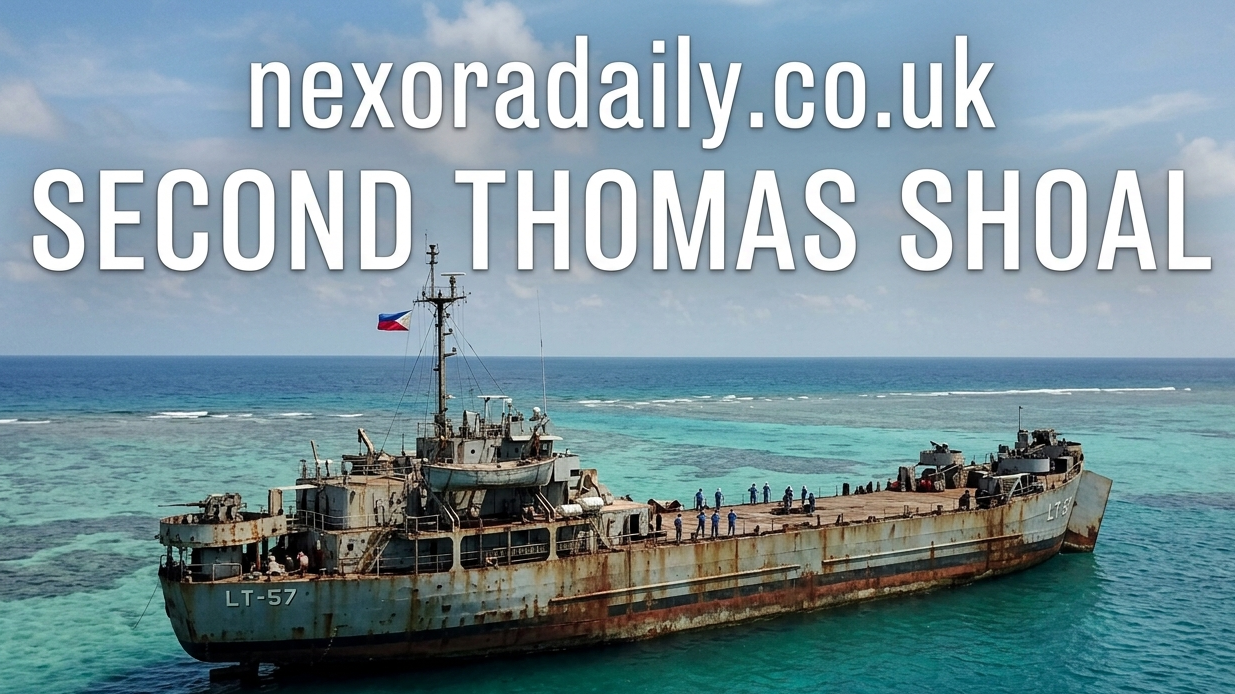
The modern history of Second Thomas Shoal began to take shape in the late 20th century as competing territorial claims in the South China Sea intensified. The Philippines, China, Vietnam, and other nations gradually increased their presence in the Spratly Islands region, leading to overlapping claims. However, a turning point occurred in 1999 when the Philippines intentionally grounded a naval vessel, the BRP Sierra Madre, on the shoal.
This strategic move was not accidental but a deliberate act to reinforce the Philippines’ claim by maintaining a physical presence in the area. Since then, the grounded vessel has functioned as a military outpost, housing rotating personnel from the Philippine Marines. Over time, it has become both a practical defense position and a symbolic marker of sovereignty.
The decision to maintain this outpost has ensured that Second Thomas Shoal remains continuously relevant in regional politics. What was once a remote reef has evolved into a long-standing flashpoint in one of the world’s most contested maritime regions.
Legal Status Under International Maritime Law and UNCLOS
The legal status of Second Thomas Shoal is closely tied to the United Nations Convention on the Law of the Sea (UNCLOS), which defines maritime entitlements and exclusive economic zones. Under UNCLOS, coastal states have rights to resources within 200 nautical miles of their coastline, which places the shoal within the Philippines’ maritime jurisdiction.
A significant development in the legal understanding of the region came in 2016 when an international tribunal ruled in favor of the Philippines in its arbitration case against China. The ruling clarified that maritime features such as Second Thomas Shoal are low-tide elevations and do not generate territorial seas or sovereign rights for other states.
Despite the ruling, enforcement remains a challenge because international tribunals rely on voluntary compliance. China rejected the decision and continues to assert historical claims in the region, leading to ongoing legal and diplomatic tension. This divergence between legal interpretation and political reality has made Second Thomas Shoal a key example of the limitations of international maritime law in resolving territorial disputes.
Strategic Importance in the South China Sea Region
Second Thomas Shoal holds strategic importance due to its location in one of the world’s busiest maritime corridors. The South China Sea is a critical passage for global trade, connecting East Asia with the Middle East, Europe, and other regions. A significant portion of global shipping passes through these waters, making control and influence over the area highly valuable.
For the Philippines, maintaining a presence at the shoal reinforces its maritime claims and strengthens its strategic depth in the western frontier. For China, the broader South China Sea is central to its regional security strategy and maritime expansion goals. This overlapping strategic interest has elevated the shoal from a minor reef to a symbol of regional power competition.
The presence of foreign naval and coast guard forces in the broader region further increases its sensitivity. Even small incidents near Second Thomas Shoal can have broader diplomatic implications, affecting relations between major regional and global powers.
The Role of BRP Sierra Madre as a Permanent Outpost
At the heart of the Second Thomas Shoal dispute is the BRP Sierra Madre, a grounded Philippine Navy vessel that has served as a makeshift military outpost for more than two decades. Originally a World War II-era ship, it was deliberately beached to establish a permanent presence on the shoal.
Over time, the vessel has deteriorated due to constant exposure to saltwater and harsh weather conditions. Despite its aging structure, it continues to house a small contingent of Philippine Marines responsible for monitoring the area and asserting sovereignty. The ship is regularly resupplied with food, water, and essential supplies through naval missions.
These resupply operations are often sensitive and closely monitored by other claimant states, making the vessel both a logistical challenge and a strategic symbol. Its continued presence reflects the Philippines’ long-term commitment to maintaining control over the area despite limited infrastructure.
Maritime Tensions and China-Philippines Encounters
Tensions around Second Thomas Shoal have increased significantly in recent years due to repeated maritime encounters between Chinese and Philippine vessels. China maintains a strong coast guard presence in the South China Sea and frequently monitors or challenges resupply missions heading toward the shoal.
These encounters sometimes involve close maneuvers, water cannon usage, and blocking tactics that create dangerous conditions at sea. While both sides often attempt to avoid direct escalation, the frequency of these incidents highlights the fragility of the situation.
Diplomatic dialogues have occasionally helped reduce tensions, but they have not resolved the underlying issues. As a result, Second Thomas Shoal remains one of the most active flashpoints in the South China Sea dispute, where even routine operations carry the risk of escalation.
Environmental and Human Conditions at the Shoal
The environmental conditions at Second Thomas Shoal are harsh and unwelcoming. The surrounding waters are exposed to strong currents, unpredictable weather, and limited natural protection. Because the shoal is submerged at high tide, it does not support permanent settlement or infrastructure beyond the grounded vessel.
Life aboard the BRP Sierra Madre is extremely difficult. Personnel stationed there operate in confined and deteriorating conditions, with limited access to modern facilities. Supplies must be regularly transported from the mainland, and extreme weather can disrupt these operations.
Despite these challenges, the stationed personnel play an essential role in maintaining surveillance and asserting presence. Their endurance reflects the broader strategic importance placed on holding the position, even under difficult environmental circumstances.
Role of International Actors and Regional Diplomacy
The Second Thomas Shoal dispute has drawn attention from international actors, particularly due to its implications for freedom of navigation and regional stability. Countries outside the region, including major global powers, have expressed concern over rising tensions in the South China Sea.
Regional diplomacy efforts, including ASEAN discussions and bilateral engagements, have sought to manage tensions and prevent escalation. However, differing interpretations of sovereignty and maritime law continue to limit progress toward a long-term resolution.
The shoal has thus become part of a larger geopolitical environment where regional disputes intersect with global strategic interests. This makes it not only a local issue but also a matter of international concern.
Future Outlook of Second Thomas Shoal and Regional Stability
The future of Second Thomas Shoal remains uncertain, shaped by legal disagreements, strategic competition, and ongoing maritime incidents. While international law supports the Philippines’ position, enforcement challenges continue to complicate the situation.
Diplomatic engagement remains the most viable path toward managing tensions, but long-term resolution will require mutual compromise and stronger regional frameworks. As long as competing claims persist, the shoal is likely to remain a sensitive and strategically important location.
Its future will also depend on broader developments in the South China Sea, including shifts in regional power balance and international maritime governance. For now, Second Thomas Shoal stands as a symbol of unresolved territorial disputes in one of the world’s most important maritime regions.
Conclusion
Second Thomas Shoal is far more than a submerged reef in the South China Sea. It represents a complex intersection of geography, international law, national sovereignty, and strategic competition. Its significance has grown not because of its physical characteristics but because of its role in shaping regional power dynamics. As disputes continue and diplomatic efforts evolve, the shoal remains a critical point of reference in understanding the broader tensions in the Indo-Pacific region.
