

Introduction
USB connectors have become an essential part of modern digital life. Whether charging a smartphone, connecting a printer, transferring files to an external hard drive, or linking multiple devices to a computer, USB technology serves as the universal standard for connectivity. The term USB stands for Universal Serial Bus, a technology developed to simplify communication between electronic devices while providing a standardized method for power delivery and data transfer.
Since its introduction in the mid-1990s, USB technology has evolved dramatically. What began as a simple solution for connecting peripherals has transformed into a sophisticated ecosystem capable of supporting ultra-fast data transfer speeds, high-power charging, video transmission, and advanced networking functions. Today, USB connectors are found in smartphones, laptops, tablets, gaming consoles, cameras, industrial equipment, automotive systems, and countless other devices.
Understanding USB connectors is increasingly important because not all USB ports and cables are the same. Different connector types, data standards, and charging capabilities can significantly impact performance. This comprehensive guide explores everything you need to know about USB connectors, including their history, types, standards, applications, advantages, challenges, and future developments.
The History and Evolution of USB Connectors
Before USB technology became widespread, connecting devices to computers was often complicated. Users had to deal with multiple connection standards such as serial ports, parallel ports, PS/2 connectors, and proprietary interfaces. Each peripheral often required a unique connector, making compatibility difficult and increasing hardware complexity.
To solve these problems, a group of major technology companies collaborated to develop the Universal Serial Bus standard. The first USB specification was released in 1996 with the goal of creating a universal interface for computer peripherals. Early adoption was gradual, but the technology quickly gained popularity because of its simplicity, plug-and-play functionality, and broad compatibility.
USB 1.1 offered data transfer speeds of up to 12 Mbps, which was sufficient for keyboards, mice, and basic peripherals. The release of USB 2.0 in 2000 significantly increased performance to 480 Mbps and accelerated adoption across consumer electronics. Over the following decades, USB 3.0, USB 3.1, USB 3.2, and USB4 introduced progressively faster speeds and enhanced capabilities, transforming USB from a peripheral interface into a comprehensive connectivity platform.
Today, USB technology continues to evolve to meet the growing demands of high-resolution media, cloud computing, artificial intelligence workloads, gaming systems, and advanced mobile devices.
Understanding How USB Connectors Work
USB connectors serve as physical interfaces that establish communication between devices. Inside each USB cable are conductors responsible for transmitting power and data. When two compatible devices are connected, the USB protocol enables them to identify one another and establish communication automatically.
One of the defining features of USB technology is its plug-and-play functionality. Unlike older connection methods that often required manual configuration, USB devices can typically be connected and recognized instantly by modern operating systems. This convenience has contributed significantly to the widespread adoption of USB technology.
USB connections support multiple functions simultaneously. A single cable can charge a device, transfer files, stream audio, deliver video signals, and communicate control information. Advanced USB standards allow dynamic management of these functions, ensuring efficient performance and compatibility across a wide range of hardware platforms.
The USB ecosystem also includes hubs, adapters, docking stations, and converters that expand connectivity options while maintaining standardized communication protocols.
USB-A Connectors and Their Continued Relevance
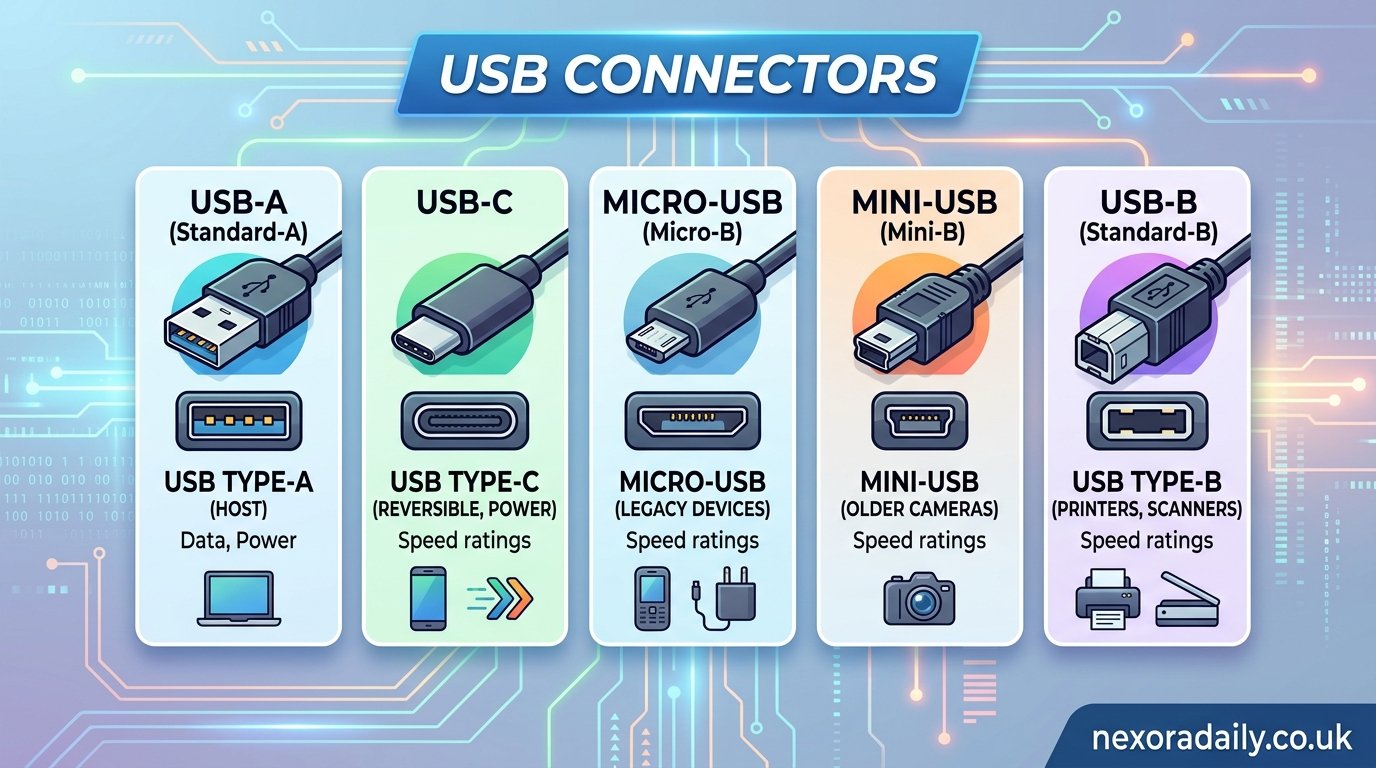
USB-A is the classic rectangular connector that most people immediately recognize. For many years, USB-A served as the primary connector on desktop computers, laptops, gaming systems, televisions, and charging adapters. Despite the emergence of newer connector formats, USB-A remains one of the most widely used USB interfaces in the world.
The popularity of USB-A stems from its durability, simplicity, and enormous installed base. Millions of devices continue to rely on USB-A connections, including flash drives, keyboards, computer mice, webcams, printers, card readers, and external storage devices. Manufacturers still include USB-A ports on many products to maintain compatibility with existing accessories.
USB-A connectors support multiple USB standards, meaning that the physical connector itself does not necessarily indicate performance. A USB-A port may support USB 2.0, USB 3.0, or later standards depending on the device. This distinction highlights the importance of understanding both connector type and underlying technology.
Although USB-A remains highly relevant, it faces increasing competition from USB-C, which offers superior versatility and a more user-friendly design.
USB-B, Mini USB, and Micro USB Connectors
USB-B connectors were developed primarily for larger peripheral devices such as printers, scanners, and external storage systems. Their square-shaped design helps prevent incorrect connections while providing reliable communication between computers and peripherals. USB-B connectors remain common in office equipment and industrial hardware.
As portable electronics became more popular, manufacturers required smaller connectors that could fit compact devices. This need led to the development of Mini USB. For many years, Mini USB connectors were widely used in digital cameras, MP3 players, handheld gaming devices, and GPS units. They offered a practical balance between size and durability.
Micro USB eventually replaced Mini USB as the preferred connector for mobile devices. Its smaller dimensions allowed manufacturers to design thinner smartphones and more compact electronics. Micro USB became the standard charging and data connector for Android devices for over a decade. It also appeared in power banks, Bluetooth headphones, wireless speakers, action cameras, and various smart devices.
Despite being gradually replaced by USB-C, Micro USB remains important because millions of legacy devices continue to depend on it. Many consumers still use Micro USB cables daily for charging and synchronization purposes.
USB-C and the New Era of Connectivity
USB-C represents one of the most significant advancements in USB connector technology. Unlike earlier connectors, USB-C features a reversible design that eliminates orientation concerns. Users can insert the connector either way, greatly improving convenience and usability.
The compact size of USB-C makes it suitable for modern devices that prioritize slim designs and portability. At the same time, USB-C offers capabilities that far exceed previous USB connectors. A single USB-C port can support data transfer, charging, video output, audio transmission, and networking functions simultaneously.
One of the major reasons for USB-C’s rapid adoption is its flexibility. Smartphones, tablets, ultrabooks, desktop computers, gaming handhelds, monitors, docking stations, and accessories increasingly rely on USB-C as their primary connection interface. Many manufacturers have transitioned entirely to USB-C because it reduces complexity and improves compatibility across product ecosystems.
USB-C also plays a central role in modern fast-charging systems and advanced display technologies. Its ability to support multiple protocols through a single connector has established it as the leading connectivity solution for current and future electronic devices.
USB Standards and Data Transfer Speeds
While connector shape determines physical compatibility, USB standards determine performance. Understanding this distinction is essential because two devices may use the same connector while offering dramatically different speeds.
USB 2.0 supports data transfer rates of up to 480 Mbps and remains common in keyboards, mice, printers, and basic peripherals. For everyday tasks such as document transfers and peripheral communication, USB 2.0 remains adequate despite its age.
USB 3.0 introduced a major leap forward with speeds reaching 5 Gbps. USB 3.1 increased bandwidth to 10 Gbps, while USB 3.2 expanded performance even further through multi-lane communication methods. These improvements enabled faster backups, quicker file transfers, and more responsive external storage solutions.
USB4 represents the latest generation of USB performance. Built on modern high-speed architecture, USB4 can support extremely demanding applications including professional video editing, high-resolution displays, external graphics processing, and enterprise-level data transfer requirements. As file sizes continue to grow and computing workloads become more intensive, these performance improvements are increasingly valuable.
USB Power Delivery and Fast Charging Innovations
Charging technology has become one of the most important aspects of modern USB development. Early USB connections were designed primarily for low-power peripherals and offered limited charging capabilities. As smartphones, tablets, and laptops became more powerful, users demanded faster and more efficient charging solutions.
USB Power Delivery, often referred to as USB PD, was created to address these requirements. USB PD allows connected devices to negotiate voltage and current levels intelligently. This dynamic communication ensures optimal charging performance while maintaining safety and efficiency.
Modern USB-C chargers using USB Power Delivery can deliver significantly more power than traditional USB chargers. Many laptops now charge entirely through USB-C ports, eliminating the need for proprietary power adapters. Smartphones can reach substantial battery levels within a short period thanks to advanced charging protocols supported by USB technology.
The growth of USB Power Delivery has also encouraged the development of universal charging ecosystems. Consumers increasingly rely on a single charger to power multiple devices, reducing electronic waste and simplifying daily device management.
Common Applications of USB Connectors Across Industries
USB connectors play a critical role in nearly every sector of modern technology. In consumer electronics, they enable charging, synchronization, data backup, multimedia streaming, and peripheral connectivity. Smartphones, tablets, gaming consoles, cameras, and wearable devices all depend heavily on USB interfaces.
Business environments utilize USB technology for printers, scanners, point-of-sale systems, conference room equipment, and storage devices. The reliability and universality of USB make it ideal for workplace deployments where compatibility and ease of use are essential.
Industrial automation systems use USB connections for diagnostics, programming, firmware updates, and machine communication. Healthcare facilities rely on USB-enabled equipment for patient monitoring, medical imaging, laboratory testing, and data management. Educational institutions use USB technology in classrooms, laboratories, and administrative systems.
Automotive manufacturers have also integrated USB connectivity into modern vehicles. USB ports support smartphone integration, infotainment systems, navigation updates, media playback, and device charging. As connected vehicle technologies continue to expand, USB remains a foundational communication interface.
Choosing the Right USB Cable and Connector
Selecting the appropriate USB cable involves more than simply matching connector shapes. Different cables support varying levels of performance, power delivery, and protocol compatibility. Choosing the wrong cable can limit charging speed, reduce data transfer performance, or prevent certain features from functioning properly.
Consumers should first verify the connector types required by their devices. USB-A, USB-B, Mini USB, Micro USB, and USB-C each serve specific purposes and are not directly interchangeable without adapters. Understanding device requirements helps avoid compatibility issues.
Cable quality is equally important. High-quality cables typically offer better shielding, improved durability, and more reliable signal transmission. Certified cables are often designed to meet established industry standards, reducing the risk of overheating, connection failures, or charging inconsistencies.
As USB technology becomes more advanced, cable specifications continue to play a critical role in achieving maximum performance. Investing in quality cables often results in better reliability and a longer lifespan for connected devices.
The Future of USB Connectors and Emerging Technologies
The future of USB technology is centered around greater performance, improved efficiency, and broader functionality. USB-C has already become the dominant connector for many modern devices, and its adoption is expected to continue expanding across consumer, commercial, and industrial markets.
Emerging technologies such as artificial intelligence, augmented reality, virtual reality, edge computing, and ultra-high-definition content creation require increasingly powerful connectivity solutions. Future USB standards are expected to provide higher bandwidth, lower latency, and more sophisticated power management capabilities to support these demands.
Sustainability initiatives may also influence USB development. Universal charging standards reduce the need for proprietary accessories and help minimize electronic waste. Governments and industry organizations continue to encourage standardized charging solutions that benefit consumers and the environment.
As connectivity requirements evolve, USB technology remains uniquely positioned to adapt. Its combination of compatibility, versatility, and continuous innovation ensures that USB connectors will remain an essential component of the digital ecosystem for decades to come.
Conclusion
USB connectors have revolutionized the way electronic devices communicate, exchange data, and receive power. From the early days of USB-A and USB-B to the modern capabilities of USB-C and USB4, USB technology has consistently evolved to meet changing user needs and technological demands. Its ability to combine charging, data transfer, video output, and device communication into a single standardized interface has made it one of the most successful technologies in computing history.
Today, USB connectors are present in nearly every aspect of modern life, from personal electronics and business equipment to healthcare systems, industrial automation, and automotive technology. Understanding the various connector types, performance standards, charging technologies, and application scenarios helps users make informed decisions when purchasing devices and accessories.
As innovation continues and connectivity requirements become more complex, USB technology is expected to remain at the forefront of digital communication. With ongoing improvements in speed, power delivery, compatibility, and efficiency, USB connectors will continue to shape the future of technology while providing the universal connectivity that modern users depend upon every day.
