

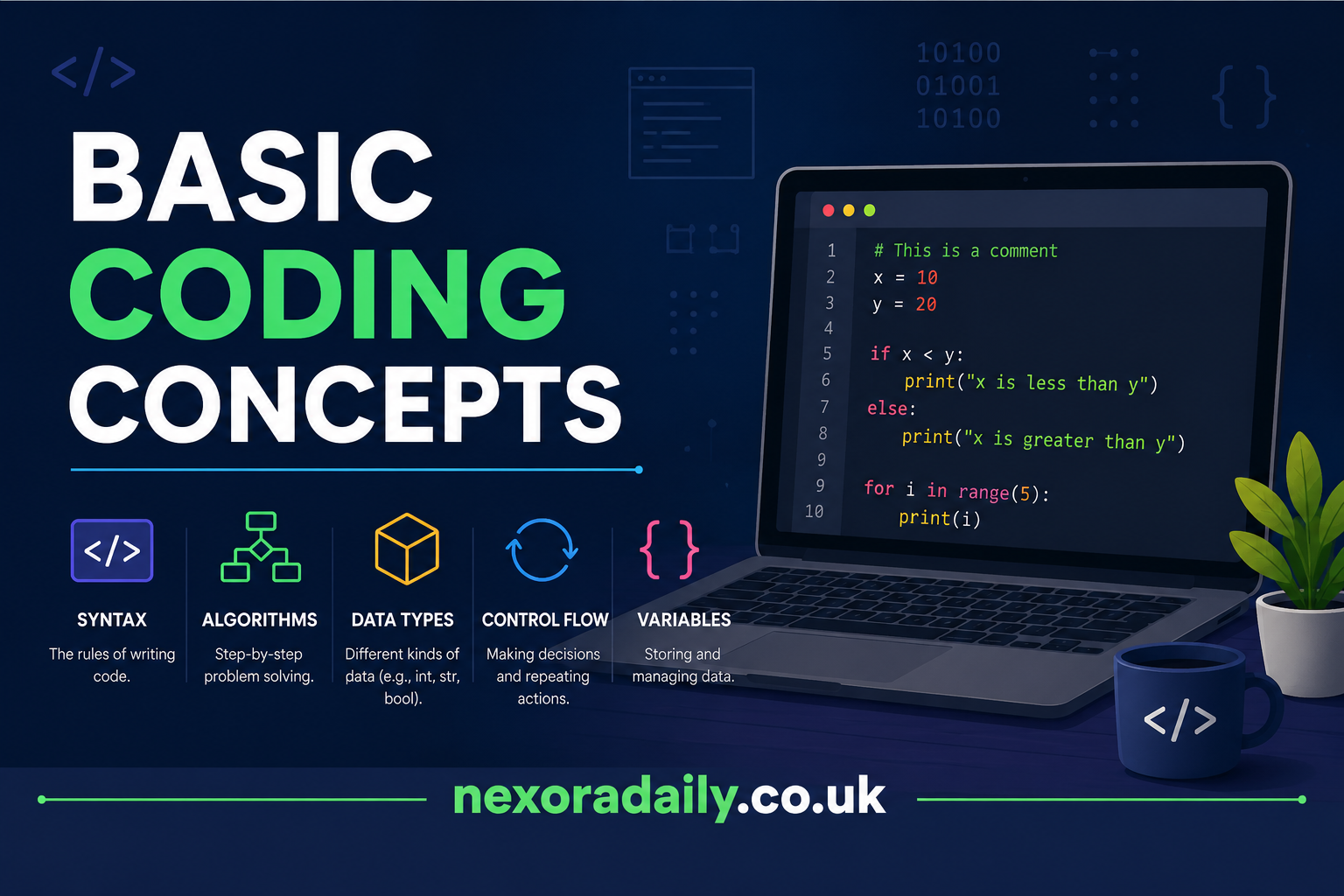
Introduction to Basic Coding Concepts
Basic coding concepts are the essential building blocks of programming that allow humans to communicate with computers in a structured and logical way. Every software application, from simple calculators to complex artificial intelligence systems, is built on these foundational ideas. Understanding them is the first step toward becoming proficient in any programming language.
Coding is not just about writing lines of text; it is about solving problems in a way that a machine can understand and execute. Developers use programming languages to convert human logic into machine-readable instructions. These instructions follow strict rules, known as syntax and semantics, which ensure that the computer interprets them correctly.
Learning basic coding concepts also develops logical thinking and problem-solving skills. It trains the mind to break complex problems into smaller, manageable steps. This structured way of thinking is useful not only in software development but also in everyday decision-making and analytical tasks.
How Computers Understand Code and Execute Instructions
Computers do not understand human languages; they operate using binary code made up of 0s and 1s. Programming languages act as an intermediary layer that translates human-readable instructions into machine code. This translation is handled by compilers or interpreters depending on the language being used.
A compiler converts the entire program into machine code before execution, while an interpreter processes code line by line. This difference affects how quickly programs run and how errors are detected. For example, compiled languages like C++ often run faster, while interpreted languages like Python are easier to debug and learn.
When a program runs, the operating system allocates memory, processes instructions, and manages input and output operations. This behind-the-scenes execution process is crucial for understanding how software interacts with hardware and why efficiency matters in coding.
Programming Languages and Their Role in Software Development
Programming languages are structured systems that allow developers to write instructions for computers. Each language has its own syntax, rules, and use cases, but all share the common goal of solving computational problems. Popular languages such as Python, JavaScript, and Java are widely used across different industries.
High-level programming languages are designed to be readable and closer to human language. They abstract complex hardware operations, making development faster and more accessible. This abstraction allows beginners to focus on logic rather than technical machine-level details.
Low-level languages, on the other hand, provide closer interaction with hardware. They offer more control over system resources but require deeper technical understanding. Knowing the difference between these types of languages helps learners appreciate how software is built from simple instructions to complex systems.
Variables, Data Types, and Memory Management
Variables are fundamental elements in coding that act as storage containers for data values. They allow programmers to store information such as numbers, text, or results of calculations. Without variables, it would be impossible to create dynamic and interactive programs.
Data types define what kind of data a variable can hold. Common categories include integers, floating-point numbers, strings, and boolean values. Each data type has specific behavior and memory requirements, which influence how the program processes information.
Memory management is closely tied to variables and data types. basic coding concepts When a variable is created, the system allocates a specific space in memory. Efficient use of memory ensures that programs run smoothly and do not consume unnecessary system resources, which is especially important in large-scale applications.
Control Flow and Logical Decision-Making in Programming
Control flow determines the order in which instructions are executed in a program. Instead of following a strict linear path, programs often make decisions based on conditions. This ability to branch into different paths is what makes software intelligent and responsive.
Conditional statements such as if, else, and switch allow programs to evaluate conditions and execute different blocks of code accordingly. basic coding concepts This concept is similar to real-life decision-making, where different outcomes depend on specific circumstances or inputs.
Control flow is essential in building interactive applications. For example, login systems, payment gateways, and recommendation engines all rely on logical decision-making structures to function correctly. Without control flow, programs would be static and unable to respond to user behavior.
Functions and the Importance of Modular Programming
Functions are reusable blocks of code designed to perform specific tasks. They help reduce repetition and improve the organization of a program. basic coding concepts By breaking complex problems into smaller functions, developers can manage code more efficiently and maintain clarity.
Each function typically takes input, processes it, and returns an output. This input-output structure makes functions predictable and easy to test. It also allows developers to reuse code across different parts of a program without rewriting the same logic repeatedly.
Modular programming, which relies heavily on functions, is a widely used approach in software development. It ensures that large applications remain structured, scalable, and easier to debug. This approach is especially important in team environments where multiple developers work on the same project.
Loops and Iteration in Programming Logic
Loops are fundamental coding structures used to repeat a block of code multiple times. Instead of writing repetitive instructions, developers use loops to automate tasks efficiently. basic coding concepts This is particularly useful when working with large datasets or repetitive processes.
Iteration allows programs to go through sequences of data, such as lists or arrays, and perform operations on each element. This makes loops essential for tasks like data processing, searching, and calculations in software applications.
Different loop structures allow for different levels of control over repetition. basic coding concepts Some loops continue until a condition is met, while others run a fixed number of times. Understanding how and when to use loops is crucial for writing efficient and optimized code.
Data Structures and Efficient Information Organization
Data structures are methods of organizing and storing data so it can be accessed and used efficiently. They play a major role in determining how well a program performs, especially when dealing with large amounts of information. Common examples include arrays, lists, stacks, and dictionaries.
Each data structure is designed for specific use cases. basic coding concepts Some are optimized for fast searching, while others are better for inserting or deleting data. Choosing the right data structure can significantly improve program performance and reduce complexity.
Understanding data structures helps developers solve real-world problems more effectively. Whether building a search engine, a social media platform, or a banking system, efficient data organization is critical for scalability and speed.
Debugging, Best Practices, and Real-World Applications
Debugging is the process of identifying and fixing errors in code. These errors, known as bugs, can occur due to syntax mistakes, logical flaws, or unexpected user input. basic coding concepts Debugging is a natural and essential part of the software development process.
Best practices in coding include writing clean, readable, and well-structured code. Developers often follow coding standards and conventions to ensure consistency and maintainability. This becomes especially important in collaborative environments where multiple programmers contribute to the same project.
Basic coding concepts are applied in countless real-world applications, including web development, mobile apps, data science, and artificial intelligence. basic coding concepts From simple websites to advanced machine learning systems, these foundational principles remain the same across all technologies.
Conclusion: Building Strong Foundations in Coding
Basic coding concepts form the backbone of all programming knowledge. They provide the essential tools needed to understand how software is created, executed, and maintained. basic coding concepts Without these fundamentals, it becomes difficult to progress into more advanced areas of development.
Mastering these concepts allows learners to think logically, solve problems efficiently, and build real-world applications. As technology continues to evolve, these core principles remain constant, making them a valuable and long-term skill for anyone interested in the field of programming.
